
Helping Your Child Cope With Injections at Home
Help Manage Pain
Many kids are afraid of the pain that comes with injections. Here are some tools to make the injection hurt less:
Buzzy®
Buzzy is a small vibrating device with cold packs. The mix of vibrations and cold helps distract the brain from feeling the injection. You can get Buzzy online by searching “Buzzy for pain.”
When using Buzzy:
- Put Buzzy and the cold packs on the injection site for 30 to 60 seconds before giving the injection.
- After 30 to 60 seconds, move Buzzy and the cold packs up just above the injection site.
- Clean the skin as directed before the injection.
- Hold Buzzy firmly, right-side up and between the injection site and the head while you give the injection. This placement is often referred to as “between the brain and the pain.”
ShotBlocker®
ShotBlocker is a small, plastic device with tiny bumps on one side that press into the skin around the injection site. The tiny bumps help distract the brain from the feeling of the injection. You can get a Shot Blocker online.
When using a Shot Blocker:
- Clean the skin as directed before the injection.
- Hold the ShotBlocker over the injection site and give the injection close to the opening.
Numbing Cream (lidocaine)
Numbing cream is a white cream that sits on the skin. The cream soaks into the skin to make the injection hurt less. Your child’s skin may get lighter where the cream was placed. This is normal and shows that the cream has soaked in enough. You can get this over the counter at a pharmacy or with a prescription.
When using numbing cream:
- Place a quarter-size amount on your child’s skin where the injection will be given. Put a clear sticker, bandage, or cling wrap over the cream to keep it in place. This also helps it soak (absorb) into the skin.
- Read the directions to see how long the cream needs to stay on. If it’s not left on for the recommended amount of time, it may not work as well.
- Remove the sticker, bandage, or cling wrap and wipe the cream off the skin.
- Clean the skin as directed.
- Give the injection.
Freeze Spray
Freeze spray is a clear, cooling spray. The cold feeling from the spray makes the injection hurt less. Do not use freeze spray on children under the age of 3. They may mistake the cold feeling as pain. You can get this over the counter or at a pharmacy with a prescription.
When using freeze spray:
- Follow the directions on the can or bottle.
- Clean the skin as directed.
- Give the injection.
Use Comfort Positioning
Comfort positions are ways to help keep your child safe, less afraid, and calmer during their injection.
Some examples of comfort positions are:
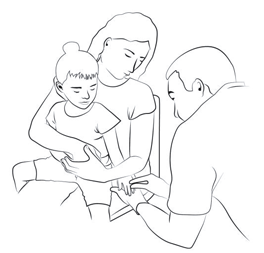
Back-to-Chest
To keep their body still:
- Have your child sit on your lap facing away from you with their back against your body.
- Wrap your arms around both of their arms.
If you need to keep the lower part of their arm still, hold that arm at or just below your child’s shoulder.
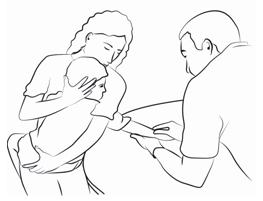
Chest-to-Chest
To keep their body still:
- Have your child sit on your lap facing you with their chest against your chest.
- Wrap their legs around your waist.
- Place their arms under your arms. Wedge the arm that will not have the injection between your body and theirs.
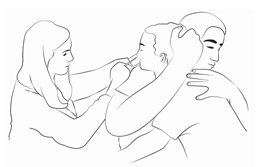
Sideways-Lap-Sit
To keep their body still:
- Have your child sit on your lap facing sideways.
- Wrap your arm around them. Hold their outside arm with your arm. Wedge their other arm between your body and theirs.
- Put their legs between yours to hold them still.
Laying-Over-Lap
To keep their body still:
- Have your child lay their belly on your lap. Their bottom should be facing up.
- Use one arm to hold your child’s legs and the other arm to hold their body.
How Your Child May Respond and How You Can Help
Toddler
How Your Toddler May Respond
Toddlers may cry, flinch or react to pain right away. They may also recognize items associated with injections, such as an alcohol swab or bandage, and become upset before the injection.
How You Can Help
- Work with the care team to choose a comfortable position and pain management plan.
- Create a soothing environment by playing a favorite song, singing softly or speaking in a calm voice.
- Offer gentle touch by rubbing their back, stroking their head, patting their bottom or holding their hand.
- Distract them with a favorite show or toy, or by blowing bubbles together.
- Comfort and play with them afterward to help them calm down and create a more positive experience.
Preschooler
How Your Preschooler May Respond
Preschoolers may be afraid because they know injections can hurt. Some may also think the injection is punishment for something they did.
How You Can Help
- Work with the care team to choose a comfortable position and pain management plan.
- Explain what will happen using simple, reassuring language. Describe the injection as a “small poke of medicine” instead of a “shot.”
- Explain each step: “I’m going to clean your skin with cold soap. Then you may feel a small poke. Your job is to stay still.” Tell them when it is finished.
- Offer appropriate choices, such as which arm or leg to use when there is a choice, whether to count to three or what activity to focus on.
- Distract them with music, stories, books, toys, a favorite show, a tablet game, conversation or bubbles.
- Practice slow breathing together. Have them pretend to smell a favorite food and then blow out birthday candles.
- Be consistent with strategies that have helped before. A sticker chart and small reward may also help.
- Praise and play with them afterward to reinforce a positive experience.
School-Age Child
How Your School-Age Child May Respond
School-age children may worry about pain or feel uncomfortable about not being in control.
How You Can Help
- Work with the care team to choose a comfortable position and pain management plan.
- Ask when they would like to know about the injection—for example, several days before or the day of the appointment.
- Explain why the injection is needed, how it will help and what they will see or feel. Let them know it is okay not to like it.
- Avoid surprises by explaining each step. You might say, “Now you may feel a small poke. Your job is to stay still.”
- Offer appropriate choices, such as helping clean their skin, choosing an injection site when options are available, counting to three or deciding whether to sit, lie down or stand.
- Distract them with music, stories, books, a favorite show, a tablet game, conversation, a comfort item or a stress ball.
- Encourage slow breathing: breathe in through the nose as if smelling a favorite food, then breathe out as if blowing out birthday candles.
- Continue using approaches that have helped during previous injections.
This patient education resource was created by Nationwide Children’s Hospital clinical staff and reviewed by Patient Education.
This information is provided for educational purposes only. It is not intended to replace medical advice, diagnosis or treatment from your child’s health care team. If you have questions about this information or your child’s care, please contact your care team.
Print-friendly versions and translations may be available. Patients and families may contact Patient Education for assistance. Medical providers should contact their physician liaison.
- Medical reviewer: Jennifer Ladd, MD, MSc, Nationwide Children's Hospital
- Last reviewed: 8/24/2026


