
Birth Control (Contraceptive) Options
The only way to completely prevent pregnancy is to not have sex. However, if you are sexually active, the best way to reduce the risk of pregnancy and sexually transmitted infections (STIs) is to use birth control, plus a condom, every time. There are many birth control (contraceptive) methods available. Some methods last for years, and some do not. Some methods have hormones; some do not. Birth control is safe, easy to use, and has few side effects. Finding the right method can help you prevent pregnancy until you want to become pregnant.
Kinds of Birth Control and Protection
- Implant
- IUD
- Shot
- Pills
- Patch
- Ring
- Condoms
- Emergency contraception
Contraceptive Implant
An implant is a small rod placed under the skin in the upper arm by a health care provider. It releases a progestin hormone. It prevents an egg from being released from the ovary and prevents sperm from reaching an egg. The implant is the size of a matchstick (Picture 1).
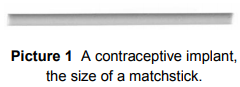
- The implant is more than 99% effective in preventing pregnancy.
- Effects are reversible once the implant is removed.
- The implant can be removed at any time by a trained professional.
- Implants last up to 5 years but can be removed sooner.
- You can get an implant right after giving birth.
- The implant is safe with breast/chest feeding.
- The implant DOES NOT protect against STIs.
Side Effects and Risks
- Lighter periods, irregular spotting, no periods, or occasional heavy bleeding
- Pain, bruising, or scarring can happen at the insertion site
- Weight gain, headache, acne, or change in mood are all possible
- A small risk of cysts on the ovaries
- Infection from insertion (rare)
- Deep insertion or moving of the implant (rare)
Intrauterine Device (IUD)
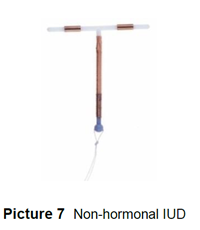
An intrauterine device (IUD) is a small, T-shaped device placed in the uterus by a doctor or health care professional.
- IUDs are more than 99% effective in preventing pregnancy.
- Effects are completely reversible once the IUD is removed.
- IUDs can be removed at any time by a trained professional.
- You can get an IUD right after giving birth.
- IUDs are safe with breast/chest feeding.
- IUDs DO NOT protect against STIs.
- There are 2 kinds of IUDs available: hormonal and non-hormonal.
- IUDs can be used as emergency contraception.
| Hormonal | Non-hormonal |
|---|---|
Made of plastic with strings attached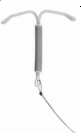 |
Made of plastic and wrapped in copper wire, with strings attached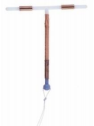 |
| Releases a hormone to keep sperm from fertilizing the egg | The copper on the IUD keeps sperm from fertilizing the egg. It does not release any hormones. |
| Lasts up to 3 to 8 years | Lasts up to 10 years |
| Many users will have lighter periods and fewer menstrual cramps. Some users may stop having periods. | Many users have heavier, longer periods. |
Side Effects and Risks
- Spotting and irregular vaginal bleeding.
- Cramping and some discomfort at insertion. Ask your health care provider or doctor about ways to manage discomfort or pain during IUD placement.
- The IUD can move or come out (expulsion). You can get pregnant if this happens.
- The risk of pregnancy is very small. If it does happen, there is an increased risk of tubal pregnancy, infection, miscarriage, or early labor and delivery.
- The risk of infection is very small. It is linked to pelvic inflammatory disease (PID). Most cases happen within the first 3 weeks and are linked to STIs like chlamydia or gonorrhea.
- It is rare, but an IUD can be pushed into and through the wall of the uterus while it is being put in. Sometimes surgery is needed to remove the IUD.
Shot
The birth control shot is given every 11 to 13 weeks in the clinic by a nurse, or you can administer it yourself at home (Picture 2). The shot releases a progestin hormone. This keeps an egg from being released. It also keeps the sperm from reaching an egg.
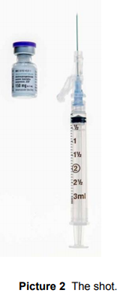
- It is 94% effective with typical use.
- The shot lasts 13 weeks.
- You can get the shot right after giving birth.
- It is safe with breast/chest feeding.
- The shot DOES NOT protect against STIs.
Side Effects and Risks
- Risk of pregnancy if you are late or miss getting your shot
- Spotting, irregular periods, or periods may stop completely
- Weight gain
- Delay in getting pregnant after stopping the shot
- Drop in bone mineral density (This usually improves after stopping the shot.)
Pills
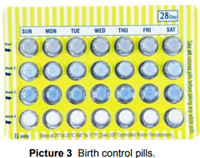
Oral contraceptive pills are birth control pills you take at the same time every day to prevent pregnancy (Picture 3). The pills have hormones that keep the egg from being released. They also keep the sperm from reaching the egg. They are available by prescription or over the counter.
- Pills are 91% effective with typical use.
- Pills should be taken at the same time every day.
- Pills DO NOT protect against STIs.
Side Effects and Risks
- Breast/chest tenderness, nausea, irregular bleeding, and headaches (most of these symptoms improve with time).
- Interactions with certain anti-seizure and HIV medicine.
- Some cause blood clots in veins and in the lungs. This is rare but can be life-threatening.
- Some cause increases in blood pressure
Patches
A contraceptive patch is a thin sticker that looks a lot like a bandage (Picture 4). The patch has the hormones estrogen and progestin in it. These hormones keep an egg from being released. They also keep the sperm from reaching the egg. It is important to remove the old patch when putting on a new one. 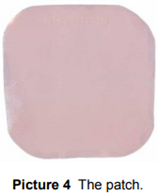
- The patch is 91% effective with typical use.
- One patch lasts for 1 week.
- The patch DOES NOT protect against STIs.
Side Effects and Risks
- Breast/chest tenderness, nausea, irregular bleeding, and headaches. Most of these symptoms improve with time.
- Less effective if you weigh more than 198 pounds.
- Interactions with certain anti-seizure and HIV medicines.
- Blood clots in veins and in the lungs.
- Increase in blood pressure.
Rings
A vaginal ring is a small flexible ring you put in your vagina (Picture 5). The ring has the hormones estrogen and progestin in it. These hormones keep the egg from being released and also keep the sperm from reaching the egg. 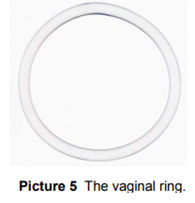
- The ring is 91% effective with typical use.
- One type of ring may last for 4 weeks, or one type can be used for up to 1 year.
- The ring DOES NOT protect against STIs.
Side Effects and Risks
- Breast/chest tenderness, nausea, irregular bleeding, and headaches (Most of these symptoms improve with time.)
- Interactions with certain anti-seizure and HIV medicines
- Blood clots in veins and in the lungs (This is rare, but can be life‐threatening.)
- Increase in blood pressure
Emergency Contraception (EC)
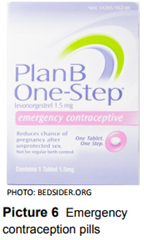
If you do not use birth control or have a birth control failure, like a broken condom, you can use emergency contraception to prevent an unplanned pregnancy. You can get emergency contraception in the form of pills (Picture 6) or an IUD (Picture 7).
- Emergency birth control pills are available at the pharmacy or from your doctor or health care provider. You don't need a prescription. The pills must be taken within 5 days of the unprotected sex, but the sooner the better.
- IUDs can be used as EC. It is placed by a doctor or healthcare provider within 5 days of unprotected sex.
Emergency contraception does not cause abortions and should not be confused with the abortion pill.
Side Effects and Risks
- Changes in your menstrual periods
- Breast/chest tenderness, nausea, headaches, dizziness, and feeling tired
When to Call the Doctor
Call the doctor or health care provider if you are having pain, have concerns about side effects, or run out of refills.
Sexually Transmitted Infections (STIs)
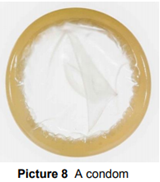
Condoms should be used for EACH sexual encounter to prevent HIV and STIs (Picture 8). Other forms of birth control DO NOT protect against HIV and STIs. Condoms alone are only 82% effective at protecting against pregnancy and should be used with another form of birth control. Condoms should be used during all sexual encounters, every time, the whole time.
Making a Plan
The choices you make about can help you stay healthy and better plan your future. Nationwide Children’s has several programs where patients can talk about sex, birth control, and STIs and get the birth control that's right for them.
- These programs can:
- Provide birth control to patients up to age 25.
- Provide same-day placements of IUDs and implants.
- Go to www.nationwidechildrens.org/BC4Teens for more birth control information.
- You can make an appointment by calling (614) 722-6200. Your Nationwide Children’s doctor or health care provider can also make an appointment for you.
Helping Hands™ Patient Education Materials
Helping Hands™ are easy-to-read guides about different illnesses, therapies, surgeries, and more. They’re created by the Patient Education team at Nationwide Children’s Hospital and are reviewed and approved by clinical staff, like nurses, doctors, pharmacists, and psychologists. Nationwide Children's Hospital is not responsible for misuse of information in patient education materials, including Helping Hands.
HH-IV-173 | ©2017, revised 2026, Nationwide Children’s Hospital


