
Medicine and Steroid Use
There are 2 types of asthma medicines:
- Controller medicines – help prevent symptoms before they start.
- Reliever (rescue) medicines – help quickly during symptoms.
Both are important because they do different jobs.
Prevent (Controller Medicines)
Controller medicines treat the cause of asthma and help prevent asthma symptoms.
- They're taken each day, even when your child feels okay. Skipping doses can lead to flare-ups.
- They help reduce swelling in the airways, keeping them open and calm.
- They lower the chance of flare-ups.
- They don't work right away. They work slowly over time.
Treat (Reliever [Rescue] Medicines)
Reliever medicines help treat asthma symptoms.
- They work quickly, within minutes.
- They help open the airways fast.
- They make it easier to breathe.
When to Use
Use reliever medicine when your child:
- Is coughing
- Is wheezing
- Has chest tightness
- Has trouble breathing
Side Effects
Most asthma medicines are safe when used the right way.
Possible side effects include:
- Sore throat
- Hoarse voice
- Dry mouth
- White patches in the mouth - This can be a sign of thrush, which may need a prescription medicine to cure.
Inhalers are the most common form of asthma medicine. They’re devices that deliver medicine directly to the lungs. There are 2 main types of inhalers. Each one is used a different way. Your child’s care team will tell you which type to use.
Dry Powder Inhaler (DPI)
A dry powder inhaler (DPI) may be shaped like a round disc or a tube. Medicine is breathed in, not sprayed. There is no canister to press that releases medicine. Your child must breathe in quickly and deeply for the medicine to get into the lungs and work well. DPIs do not use a spacer.
How to Use
- Do not shake the inhaler.
- Prepare the inhaler as directed. Each dry powder inhaler works a little differently.
- Breathe out fully away from the inhaler.
- Place the mouthpiece in the mouth and close the lips tightly around it.
- Breathe in quickly and deeply.
- Hold breath for about 10 seconds if able, then breathe out.
- Rinse the mouth with water or brush teeth after using the inhaler. This helps prevent thrush, a yeast infection in the mouth.
Spray (Puff) Inhaler
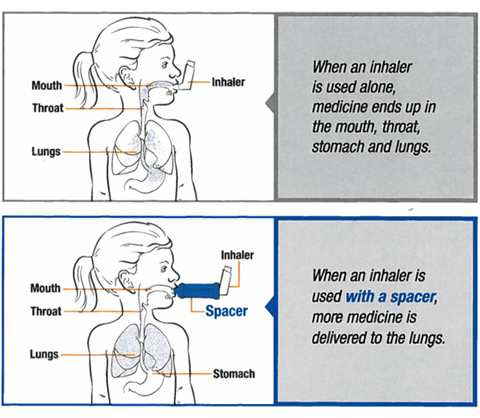
A metered dose inhaler (MDI) is usually L-shaped. Medicine is released by pressing the canister. Your child breathes the medicine in slowly and deeply through a spacer. An MDI should always be used with a spacer.
A spacer is a clear tube that attaches to a spray (MDI) inhaler. The medicine is sprayed into the spacer, then breathed in. It helps more medicine reach the lungs instead of staying in the mouth.
Types of Spacers
There are 2 types of spacers – spacers with a mask and spacers with a mouthpiece. Your child needs to use a spacer each time they use an inhaler.
- A spacer with a mask fits over the nose and mouth. It’s usually used for infants and young children who cannot use a mouthpiece.
- A spacer with a mouthpiece goes inside the mouth. It’s usually used for older children who can close their lips tightly around the mouthpiece.
- Your child’s care team will tell you which type of spacer to use.
Using a Spacer With a Mask
- Make sure the spacer is clean and dry. If it’s not, see cleaning steps below.
- Prepare the inhaler by:
- Removing the cap.
- Priming it if needed. Inhalers need to be primed if they’re new or haven’t been used in 2 weeks or more. To prime it, shake the inhaler well, then spray 2 to 4 puffs into the air. Follow the inhaler manufacturer’s instructions.
- Shake the inhaler for 10 seconds.
- Place the inhaler mouthpiece into the rubber end of the spacer.
- Gently place the mask over your child’s nose and mouth. Make sure it fits snugly with no gaps. A tight seal helps your child get the full dose.
- Press down on the inhaler canister to release 1 puff.
- Keep the mask in place while your child breathes in and out slowly 6 to 8 times.
- If more than 1 puff is ordered:
- Wait at least 60 seconds (1 minute) between each puff.
- Repeat steps 5 through 7.
Using a Spacer With a Mouthpiece
- Make sure the spacer is clean and dry. If it’s not, see cleaning steps below.
- Prepare the inhaler by:
- Removing the cap.
- Priming it if needed. Inhalers need to be primed if they’re new or haven’t been used in 2 weeks or more. To prime it, shake the inhaler well, then spray 2 to 4 puffs into the air. Follow the inhaler manufacturer’s instructions.
- Shake the inhaler for 10 seconds.
- Place the inhaler mouthpiece into the rubber end of the spacer.
- Have your child breathe out fully.
- Place the mouthpiece of the spacer in your child’s mouth. Have them close their lips tightly around it.
- Press down on the inhaler canister to release 1 puff.
- Have your child breathe in slowly and deeply. If you hear a whistling sound, they’re breathing too fast.
- Have your child hold their breath for about 10 seconds, then breathe out slowly.
- If more than 1 puff is ordered:
- Wait at least 60 seconds (1 minute) between each puff.
- Repeat steps 5 through 9.
Cleaning a Spacer
Clean the spacer 1 to 2 times each week.
- Take the spacer apart:
- Spacer with a mask: Take the 3 pieces of the spacer apart – backpiece (rubber ring), spacer chamber, and mask.
- Spacer with a mouthpiece: Remove the backpiece (rubber ring) from the spacer and the mouthpiece cap.
- Place all parts in the top rack of a dishwasher or soak in a bowl of warm, soapy water. Use dish soap to loosen any dirt you can see. Do not scrub or use a brush.
- Gently move the pieces into a bowl of clean, warm water. Do not rinse under running water. This can damage the valve.
- Shake off extra water and place on a clean surface to dry. Do not dry with a cloth or paper towel.
- Make sure all parts are completely dry before putting them back together.
Getting a New Spacer
If your child’s spacer is damaged or lost, tell their doctor or health care provider. You can get a prescription for a new one. Spacers are available at most pharmacies and some clinics.