
Common Orthopedic Conditions in Kids Bowed Legs and In-toeing

As your baby grows and starts to stand and walk, you may have noticed that their legs look a little different. Parents often notice that their young child’s legs are curved outward and/or their feet turn in when walking. This is quite common in infants and toddlers. It often occurs due to their position in the womb while growing.
Bowed Legs
Genu varum (bowed legs) is when the legs curve outward instead of being straight (Picture 1). Most babies have a natural curve in their legs from birth. This curve is often noticed as your baby starts to stand and walk, which is around 6 to 12 months of age.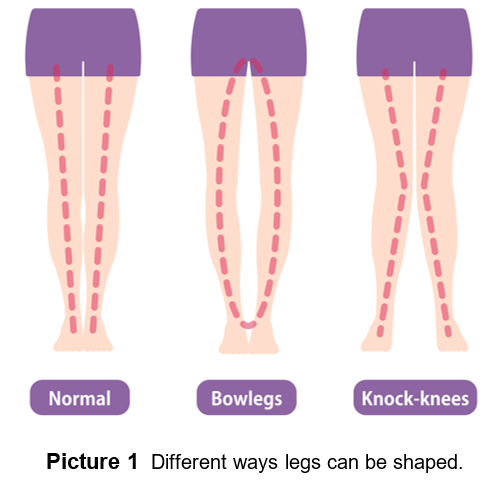
- Treatment is not usually needed.
- As babies grow, their bowed legs slowly grow straight. This usually happens by 2 years of age.
- Bowed legs can be diagnosed with an exam by your orthopedic provider. An X-ray is usually not needed.
- Leg braces are not needed to correct bowed legs.
- If bowing continues past 2 years of age, more tests may be done. Your child may also need to follow up with their provider if one leg bows worse than the other.
In-Toeing
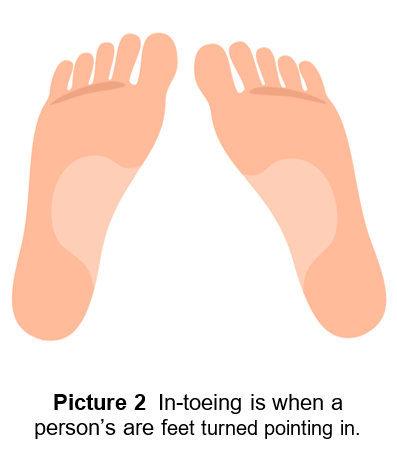
In-toeing is when a child’s feet turn in rather than straight ahead (Picture 2). Sometimes this is called pigeon-toed. Most of the time, in-toeing is present from birth.
- It may not be noticed until your child starts to stand and walk. It may be more obvious once your child starts to run.
- As your child grows, in-toeing should go away on its own. Most children outgrow in-toeing by the time they are 8 years of age.
- Medical treatment is usually not needed. In
the past, children were often given braces
or special shoes. Now we know that this is
not needed. It does not speed up or change
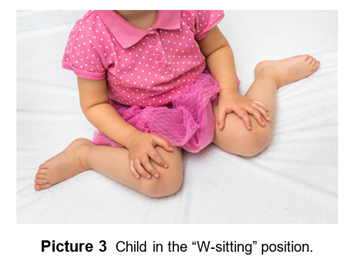
the outcome. - Children with in-toeing also tend to be very flexible. Urge them to sit with their legs in front of them or crisscross-apple sauce. Sometimes children with in-toeing will “W-sit” with their legs out underneath them (Picture 3).
- The W-sitting position can cause the hip to turn inward. This sitting position should be avoided.
HH-I-188 ©2021, Nationwide Children’s Hospital

