
Comprehensive Center for Bronchopulmonary Dysplasia
Providing Lifesaving Treatment When Others Can’t
Breakthrough Research, Comprehensive Care
Our groundbreaking treatment protocols are greatly improving outcomes for even the smallest babies.
Comprehensive Center for Bronchopulmonary Dysplasia (BPD)
Bronchopulmonary dysplasia (BPD), also known as chronic lung disease, causes long-term breathing problems for premature babies, often resulting in poor growth and development.
At Nationwide Children’s Hospital, we save babies from around the world with the most severe cases of BPD. Thanks to our cutting-edge research, innovative treatment approach and one-of-a-kind facility, our patients have:
- A 99% survival rate
- Shorter hospital stays
- Fewer readmissions
Additionally, our inpatient and outpatient programs work together to help babies reach developmental markers, with the majority of patients catching up to age-appropriate milestones by the age of 3.

Nationwide Children's Hospital is ranked by U.S. News & World Report for Neonatology.
We Treat the Whole Family. At the Hospital and at Home.
We treat babies, regardless of their level of BPD severity (see the differences between BPD and severe BPD below), using a hybrid model of care that focuses on intensive therapy, including advanced ventilator settings that are shown to increase survival rate. We also place special emphasis on neurodevelopment by comforting your baby through massage, music, speech and/or physical therapies, and involve you in your baby’s care whenever possible.
BPD places extreme demands on families. Education is a critical component for families so they are well informed, have realistic expectations, and understand their child’s care plan. As parents, you play a vital role in the progress and development of your baby, both during your hospital stay and at home.
Whether you’re a patient for a few weeks or a few months, our care for your family doesn’t end when you leave the hospital. Our team is available 24/7 to answer any questions. If you live locally, your baby will continue treatment in our outpatient program. If you live outside of our region, we work with your local health care team to make sure your child continues to thrive.
What Is BPD?
Bronchopulmonary Dysplasia (BPD) is a term used to describe long-term breathing problems for premature babies.
BPD develops most often in premature babies born with underdeveloped lungs. It is also called chronic lung disease. It involves abnormal development of the lungs, and in the most severe cases the lungs are scarred and inflamed. BPD is also associated with poor growth, development and social functioning of the baby and family.
What Does BPD Look Like?
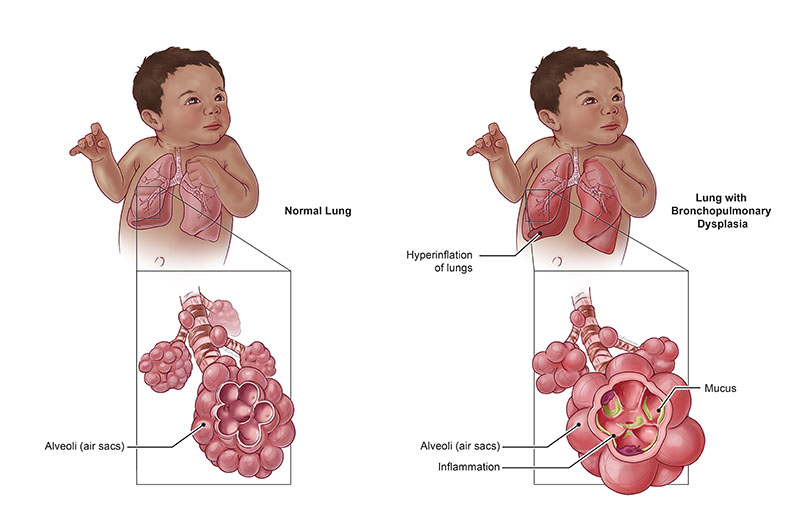
It is important to correctly define BPD for each patient as treatment plans vary. At Nationwide Children’s, we define BPD by the following guidelines:
Defining BDP at Nationwide Children's
| Age | Airway Support | Diagnosis |
| 28 days of life | Any supplemental oxygen | Some form of BPD |
| 36 weeks adjusted | Positive pressure (supplemental oxygen or CPAP) | Severe BPD |
| 36 weeks adjusted | Ventilator | Super severe BPD |
Our Expert Team is Dedicated to Your Child.
Our Comprehensive Center for Bronchopulmonary Dysplasia (CCBPD) addresses the medical, nutritional, developmental and social needs of patients diagnosed with BPD. We offer an inpatient unit and outpatient follow-up service dedicated to patients with Bronchopulmonary Dysplasia.
The entire BPD team serves the baby and family by using evidence-based practice and research to continuously improve care — all while creating an environment that empowers families to actively participate in their child’s progress.
Inpatient BPD Team
The inpatient CCBPD Newborn Intensive Care Unit (NICU) is one of three NICUs on Nationwide Children's Hospital main campus. The unit is comprised of 24 beds. We care for babies from 36 weeks corrected gestation up to approximately 2 years old. Our patients come from the central Ohio region, as well as states across the country.
The inpatient BPD team is comprised of many dedicated and focused medical professionals who have a passion for providing excellent care to this special infant population. We care for patients needing mechanical ventilation via endotracheal tube or tracheostomy, CPAP, SiPAP and nasal canula. We focus on respiratory support, nutrition, developmental milestones and family-centered care to attain best outcomes for infants and their families.
In addition to board-certified neonatologists, the BPD team consists of:
- Case Managers
- Certified Nurse Practitioners
- Pharmacists
- Physical and Occupational Therapists
- Respiratory Therapists
- Social Workers
- Speech Therapists
- Staff Nurses
Outpatient BPD Team
The outpatient clinics provides a unique medical home designed to minimize emergency room visits and hospital admissions. Since its inception in 2004, the center decreased babies’ readmission rates from over 30% to less than 10%, while at the same time improving pulmonary outcomes with the use of supplemental oxygen, bronchodilators, steroids and diuretics.
At each outpatient visit, babies are seen by a:
- Physician
- Certified Nurse Practitioner
- Nurse Clinician
- Nutritionist
- Social Worker
- Physical Therapist
- Occupational Therapist
The Nation’s Only Dedicated BPD Unit
Our Comprehensive Center for Bronchopulmonary Dysplasia is the nation’s only dedicated BPD unit. With 24 beds, this Newborn Intensive Care Unit (NICU), one of three on the main campus of Nationwide Children’s, treats more patients with BPD than any other health system in the United States.
It features:
- Inpatient and outpatient services.
- A combination of single-patient and multi-patient rooms, depending on the needs of the child and family.
- Space to accommodate a baby’s daily therapy and parent bonding sessions to help prepare families for their transition home.
- Large, open windows allowing for visual development (natural light helps premature babies grow).
Locations

Resources for Families
We are a nationally ranked hospital, so no matter where you’re from, our team is here to help:
- We have state-of-the-art transport services to help get your baby to our location safely so they can get the treatment and care they need.
- The Global Patient Services team offers financial assistance, translators and help with travel arrangements.
- We are home to the world’s second-largest Ronald McDonald House. Conveniently located right on our main campus, just steps away from the hospital, it allows you to remain a part of your child’s care while providing you a home away from home.
- Our Family Resource Center, located inside the hospital, supports patients and families during their time at Nationwide Children’s. It provides space for you to relax, exercise, do laundry, take a shower, get a haircut or use a computer while staying close to your baby’s bedside.
- Research and innovation is at the forefront of what we do. As part of the Center for Perinatal Research, we are able to develop cutting-edge clinical interventions and share our learnings across the globe.
Resources for Professionals
With the only unit dedicated to BPD in the United States, Nationwide Children’s is a leader in BPD treatment. As a founding member of the BPD Collaborative, a group of more than 25 health care organizations looking at ways to improve care of BPD patients, we are on a mission to share what we’ve learned with other health care organizations to improve outcomes for babies everywhere.
Our cutting-edge research has led to the use of aggressive ventilator settings that are shown to increase survival rate. Download our guide to learn more about these unique ventilator strategies and goals.
We are available 24/7 to answer peer questions or provide a consult.
Learn more about the BPD Collaborative.
Dedicated to providing best outcomes, our team is leading the charge in innovative treatment approaches and cutting-edge research. Learn more about our current initiates.
Arrange a Consult
Call the Physician Direct Connect Line toll free at (877) 355-0221, for physician consults and to coordinate a patient transport, 24 hours a day, seven days a week.


